published on
The Missing Link in Enterprise AI: Why Context and Behavior Are the New Security Perimeter

I spend a lot of time on the road, and over the past few months, my conversations with CISOs and business leaders across the US, the Middle East, and India have all converged on a single, urgent theme: Enterprise AI is breaking traditional data security.
In the US, the push is all about speed—deploying AI assistants to accelerate innovation and outpace competitors. In the Middle East, the conversation is heavily anchored in data sovereignty, national security, and stringent compliance. In India, the focus is on scaling operations and managing the sheer volume of AI agents interacting with vast enterprise systems.
Yet, regardless of the region or the regulatory environment, the foundational challenge is identical. When leaders look to secure their environments, they often start by evaluating traditional Data Security Posture Management (DSPM) vendors—looking at tools from Cyera, Securiti, Concentric, Cyberhaven, or Varonis—to map their sensitive data. But they quickly realize that visibility is only half the battle.
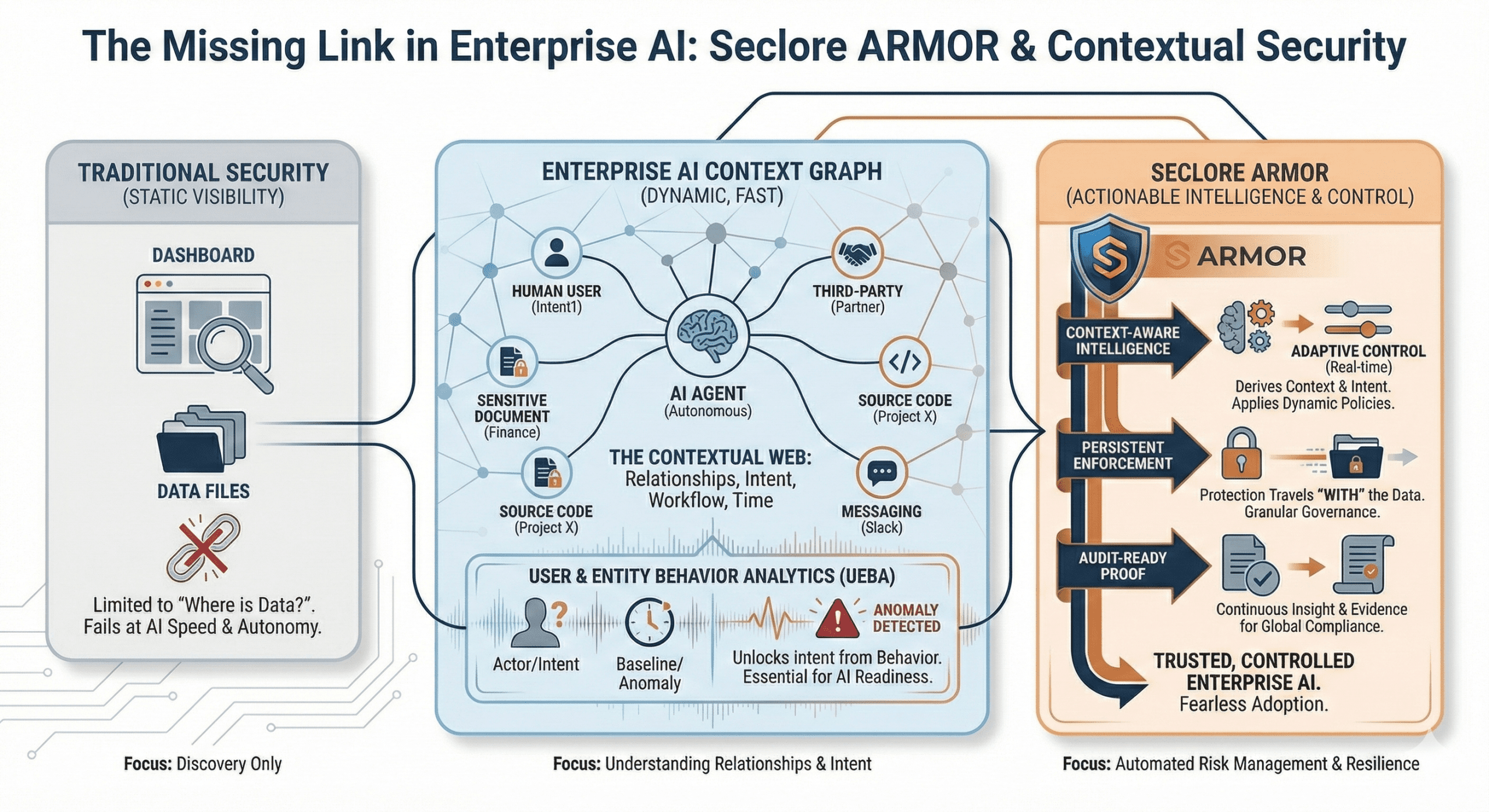
Knowing where a sensitive file sits on a dashboard doesn’t help when an autonomous AI agent suddenly accesses, summarizes, and redistributes that data at machine speed. To safely deploy AI, discovery cannot be the finish line. It must be the exact moment control begins.
The Double-Edged Sword of the Context Graph
To understand why traditional security falls short, we have to look at how modern AI actually works. Enterprise AI assistants, such as Glean or Microsoft Copilot, rely on knowledge graphs and now more increasingly context graphs.
A knowledge (or context) graph doesn’t just index files like a traditional search engine; it maps the intricate web of relationships between entities, actions, intent, and time. It understands that “Project X” connects a specific developer to a specific piece of source code, during a specific timeline, alongside relevant Slack messages and Jira tickets.
This reasoning layer is what makes AI incredibly powerful and accurate. However, it is also a nightmare for static security models. If your security architecture doesn’t understand the context graph, your AI might inadvertently surface a highly confidential board deck or an unannounced M&A document just because an employee asked a loosely related question. When permissions are flat and static, a single over-privileged AI model becomes an enterprise-wide leak.
Why User and Entity Behavior is the Key to Intent
You cannot secure AI without understanding intent, and intent is derived from behavior. This is why User and Entity Behavior Analytics (UEBA) is no longer just a nice-to-have; it is a critical component of AI data readiness.
When a piece of sensitive data is accessed, security controls must dynamically assess the situation:
- The Actor: Is this a normal human employee requesting a document, a third-party partner, or an automated AI agent?
- The Baseline: Does this align with normal operations? A user downloading five files for a weekly report is routine; an AI agent or compromised account pulling 5,000 files in three seconds is an anomaly.
- The Intent: What is the business workflow driving this action?
By analyzing behavior, we can differentiate between a routine productivity task and a critical data exfiltration risk, allowing us to enforce security policies that adapt in real time.
Enter Seclore ARMOR: Turning Understanding Into Action
This paradigm shift is exactly why we built Seclore ARMOR (Automated Risk Management Orchestration and Resilience) and repositioned Seclore as a Data Security Intelligence company. We designed ARMOR specifically to close the execution gap in AI security.
Instead of stopping at alerts and dashboards, ARMOR actively protects your data by integrating with the way AI works:
- Context-Aware Intelligence: It continuously derives the context, behavior, and intent of data usage to apply adaptive security controls in real time.
- Persistent Enforcement: Protection physically travels with the data. Whether it’s sitting in a cloud, shared with a vendor, or ingested into an enterprise AI’s context graph, your granular governance remains intact.
- Audit-Ready Proof: It delivers continuous insight and evidence of compliant data handling, ensuring you can demonstrate responsible AI use to regulators and stakeholders across the globe.
Enterprise AI will only scale when the data it relies on is trusted and controlled. With ARMOR, we are empowering organizations to move beyond reactive risk management and embrace AI fearlessly, without slowing down the business.
he Sola Security team asked a good question: why does a single query trigger a full Drive enumeration? That is a question for AI providers to answer. The parallel question — what context does your security infrastructure have over the data AI can reach? — is one every enterprise can answer for itself, starting now.