published on
Data Protection Begins at Discovery: Why DSPM Must Evolve for the AI Era
Most DSPM tools were built to find sensitive data. Not to understand it. That gap is where breaches happen, audits fail, and AI adoption creates risk nobody mapped.

The assumption underneath every DSPM dashboard
Every security team knows this moment. The scan runs. The tool reports 94% completion. A heat map appears. A risk score is generated. Someone in the meeting says: good, we now know where our sensitive data is. Let’s move on to controls.
That phrase: “We know where our sensitive data is,” is one of the most dangerous assumptions in modern security.
What you know is where the tool found data that matched the pattern it was looking for. Those two things are not the same. And the gap between them is where most data security programs fail, because discovery has been treated as a checkbox, not a foundation.
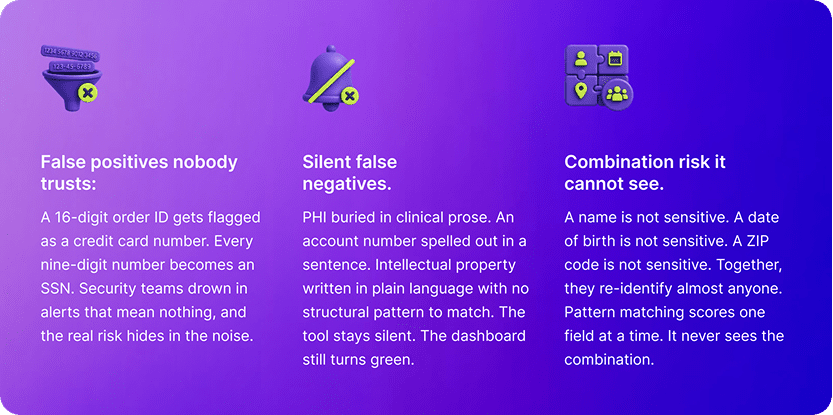
Three ways pattern matching fails
Most DSPM tools are built on regex or retrofitted machine learning. Both approaches look at data in isolation. Both fail at the same thing: context.
“A metal detector finds metal. It stays silent for ceramic, plastic, and wood, and it never tells you it missed anything. Your DSPM works the same way.”
Sensitivity is not a property of data. It is a property of context.
The same nine digits in an HR record beside a name and hire date is a regulated Social Security number. The same nine digits in a server log, as a sample transaction ID, is noise. Same pattern. Completely different risk.
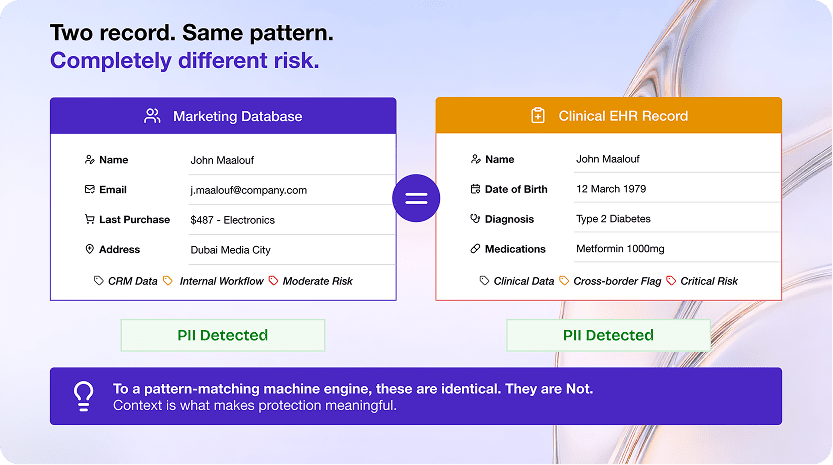
The only things that tell them apart are everything around them: location, neighboring fields, the purpose of the record, and the applicable regulation.
Strip that context out and every classification is a guess.
This is why most platforms that claim to be “context-aware” fall short. For most vendors, context means metadata: where the file lives, who owns it, when it was last touched. That is useful but shallow. Real context is about meaning, the content surrounding the data, where it came from, why it was created, and what regulation applies in this jurisdiction for this data type.
AI makes a weak foundation dangerous
Every AI agent, Copilot, and automated workflow in your enterprise consumes data that your discovery layer has classified. If that classification is wrong, the AI operates on wrong information, without any human review.
A discovery error is no longer just a discovery problem. It travels downstream. It becomes a policy problem, a controls problem, an audit problem, and an AI governance problem simultaneously. Every step of the chain operates within the rules. The data is still exposed.
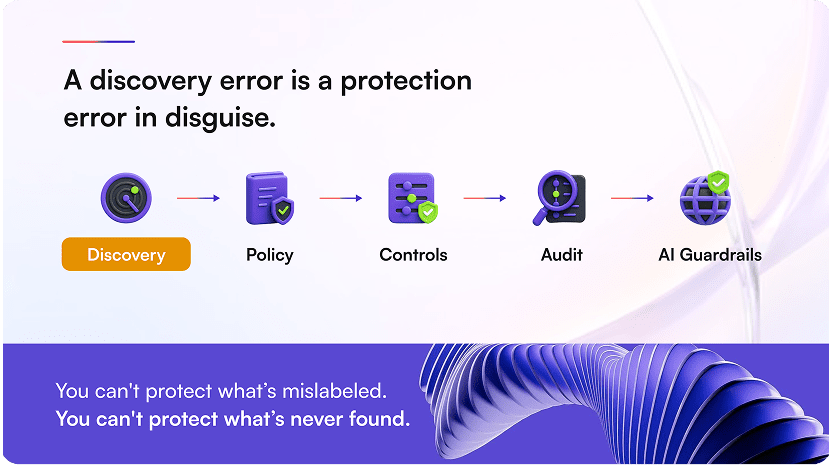
What context-aware DSPM look like
The fix is not a faster metal detector. It is a different instrument.
ARMOR DSPM reads three dimensions simultaneously. Content: what type of sensitive data the file contains. Context: which business function it belongs to, who owns it, and where it sits in the organization. Intent: what the asset is for, whether it is a payroll file, a vendor contract, or an M&A document.
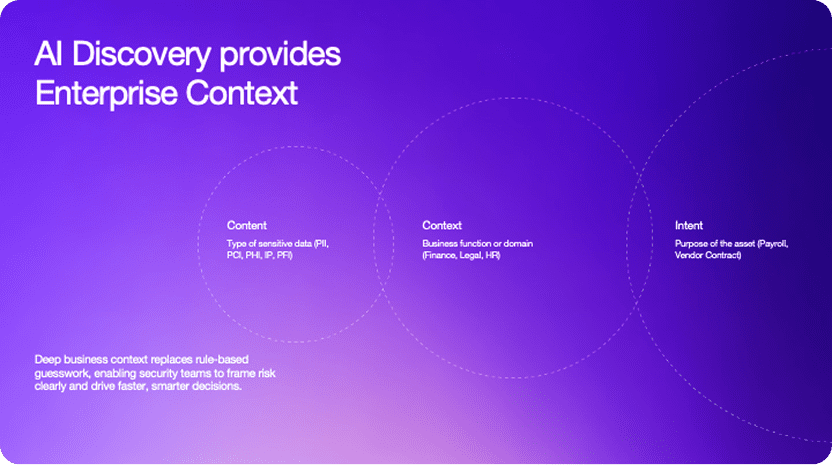
When all three are in play, security teams stop looking at a list of PII detections and start looking at a risk-optimized view they can act on. Classification becomes a decision, not a flag. And because the system is AI-native, a new data category takes a plain-English description to onboard, not a six-month training cycle.
Discovery is the foundation. If the foundation is wrong, everything built on top of it is wrong too. The goal is not a tool that finds more. It is a tool that understands what it found.