published on
Three Generations of DSPM: What Each Era Got Right (and What Each One Left Open)

You’ve sat through the DSPM demos. The dashboards fill in. The sensitive-data inventory grows. The slide says visibility has improved.
Somewhere around the third version of that pitch, the useful question changes. What happens next?
If the answer is another dashboard, another ticket, or another handoff, the program still has a gap. Intelligent DSPM starts there. It treats discovery as the beginning of a control loop, not the finish line.
Every generation of Data Security Posture Management (DSPM) has solved something real. Pattern matching, trainable classifiers, and LLM-based discovery weren’t mistakes. They were the right answers for their eras.
But the question itself has shifted. In 2026, the hard part isn’t only finding sensitive data. It’s protecting it across AI pipelines, proving control, and doing both inside environments where data can’t leave your perimeter.
Gen 3+ DSPM is Seclore’s model for Intelligent DSPM. It combines AI-native discovery, sovereign-ready architecture, native remediation, and three-layer intelligence so security teams can move from finding sensitive data to protecting it and proving control.
The rest of this piece traces what each DSPM generation got right, and where the architecture stopped short.
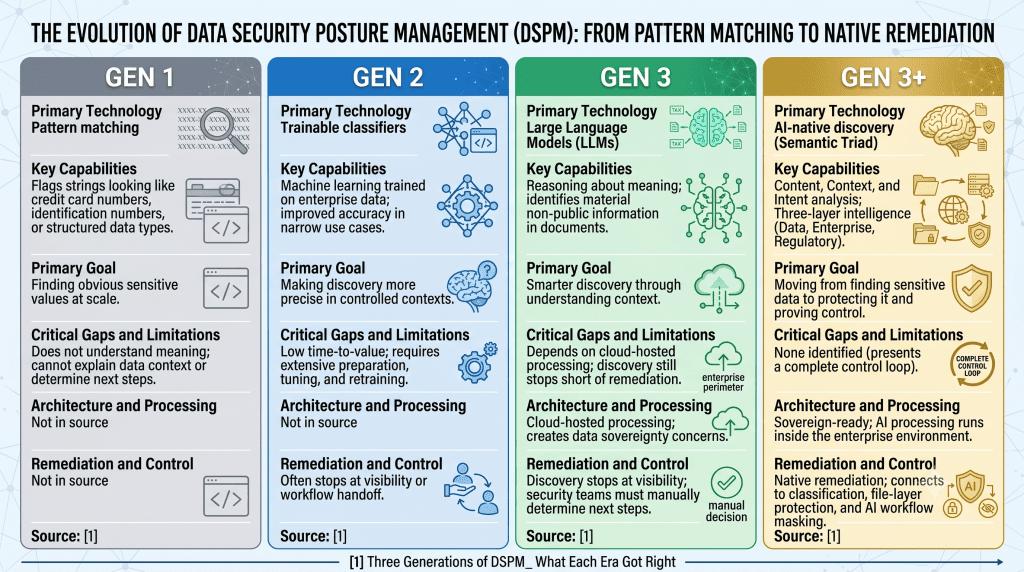
How did DSPM evolve through three generations?
The useful way to read DSPM’s history isn’t as a list of winners and losers. Each generation answered the question buyers were asking at the time. Each also left a gap that became harder to ignore as data use changed.
What did Gen 1 DSPM solve?
Gen 1 DSPM used pattern matching to identify sensitive data by known formats. It could flag strings that looked like credit card numbers, identification numbers, or other structured data types.
That approach was useful when the hard part was finding obvious sensitive values at scale. But pattern matching doesn’t understand meaning. It can identify a format, but it can’t explain whether the data is part of a customer contract, a financial model, or a regulated record that needs a specific control.
Gen 1 gave teams a starting point. It made sensitive-data discovery possible, but it couldn’t tell security teams what the data meant or what should happen next.
What changed with Gen 2 DSPM?
Gen 2 DSPM introduced trainable classifiers. Instead of relying only on patterns, these tools used machine learning trained on enterprise data.
That improved accuracy in narrower use cases, especially when organizations had enough examples to train around a specific data type or business process. The tradeoff was time-to-value. Classifier projects can require preparation, examples, tuning, and retraining before teams trust the output.
Gen 2 made discovery more precise in controlled contexts. It still left teams with the operational work of making classification useful.
Why did Gen 3 DSPM matter?
Gen 3 DSPM brought large language models into data discovery. Instead of reading a file as a set of patterns or labels, LLM-based tools can reason about meaning. A merger document isn’t just a PDF with names in it. It may contain material non-public information that needs specific handling.
That was a genuine step forward for discovery.
But the Gen 3 pattern in Seclore’s taxonomy still leaves two core gaps. First, LLM-based discovery often depends on cloud-hosted processing, which can create data sovereignty concerns for regulated enterprises. Second, discovery still stops short of remediation. The tool finds the risk, then the security team has to work out what happens next.
Gen 3 made discovery smarter. It still left the control question sitting outside the discovery tool.
What makes Gen 3+ DSPM different?
Gen 3+ DSPM adds the architecture required to act on discovery. This isn’t a version number. It’s a shift in what DSPM is expected to do after it finds something.
Gen 3+ DSPM requires four capabilities working together:
- AI-native discovery from day one: Data is analyzed through the Semantic Triad of Content, Context, and Intent, so discovery starts with meaning rather than static patterns.
- Sovereign-ready architecture: AI processing runs inside the enterprise environment so data doesn’t need to leave the customer’s control for classification.
- Native remediation: Discovery connects to classification, file-layer protection, AI workflow protection, and proof, rather than ending in another queue.
- Three-layer intelligence: Decisions account for Data Context, Enterprise Context, and Regulatory Context, not data context alone.
This is why the better evaluation question isn’t only, “Can my DSPM find sensitive data?” The better question is, “Can it help my team decide what to do next, and can it carry that decision into control?”
How does ARMOR DSPM use the Gen 3+ model?
ARMOR DSPM by Seclore is the intelligent discovery entry point into the ARMOR platform. It discovers and contextualizes sensitive data, then feeds the rest of the platform so findings don’t stop as findings.
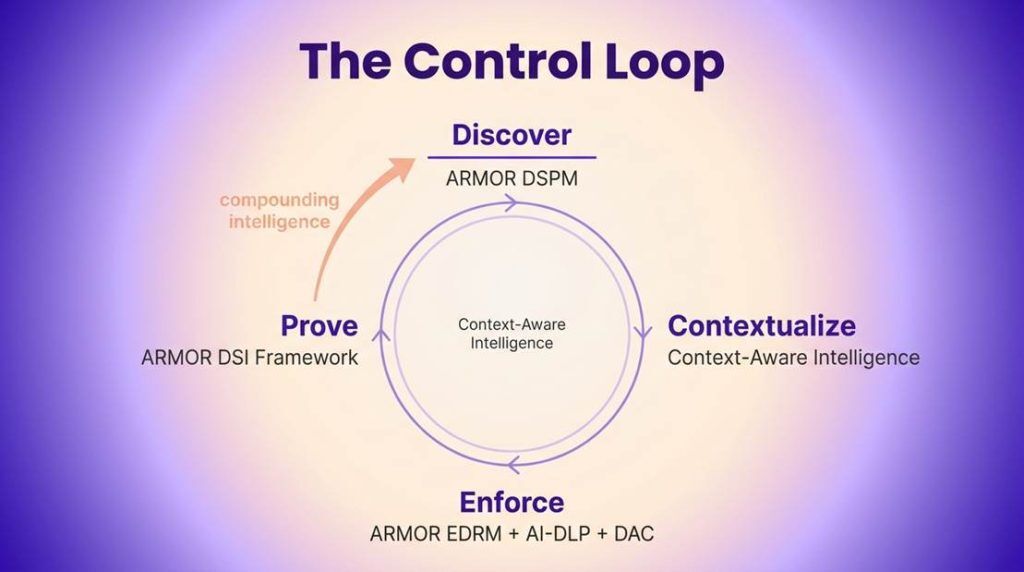
The platform sequence is locked: Discover, Contextualize, Enforce, Prove.
| Capability | Earlier DSPM generations | Gen 3+ DSPM in ARMOR |
| Discovery | Finds sensitive data through patterns, classifiers, or LLM-based analysis | Uses AI-native discovery through the Semantic Triad |
| Data sovereignty | May require external processing depending on architecture | Runs self-hosted AI inside the enterprise environment |
| Remediation | Often stops at visibility or workflow handoff | Connects discovery to classification, protection, masking, and proof |
| Intelligence | Focuses mainly on data context | Adds enterprise context and regulatory context |
| Business value | Reports where risk exists | Helps teams prioritize what matters and act on it |
| Compliance | Reports findings | Enforces controls and supports proof of compliance |
| AI workflows | Limited coverage after data moves into AI use | Extends protection through ARMOR AI-DLP inside the AI workflow |
The important part isn’t the table. It’s the connection behind it.
ARMOR DSPM feeds Context-Aware Intelligence. That intelligence helps drive ARMOR DAC for Data-Aware Classification, ARMOR EDRM for persistent file-layer protection, ARMOR AI-DLP for AI workflow protection, and ARMOR DSI Framework for proof.
Every stage strengthens the next one. Discovery informs classification. Classification drives enforcement. Enforcement and usage telemetry feed proof. Proof feeds Context-Aware Intelligence back into future decisions.
That connection is what changes the role of DSPM. It becomes part of a Data Security Intelligence platform rather than another source of findings.
Why does Gen 3+ DSPM matter for AI adoption?
AI changes where data security has to operate.
Sensitive data doesn’t only sit in repositories waiting to be scanned. It can move into prompts, retrieval layers, copilots, models, and AI agents. If a security program stops at discovery, it leaves a gap between knowing that sensitive data exists and controlling how that data gets used.
Gen 3+ DSPM closes that gap by connecting discovery to enforcement surfaces:
- File layer: ARMOR EDRM applies persistent rights management that travels with the file.
- AI context layer: ARMOR AI-DLP delivers real-time dynamic masking for AI and LLM use cases.
- Governance and proof layer: ARMOR DSI Framework gives teams evidence that controls are working.
ARMOR AI-DLP is especially important for AI workflows. It provides AI-native data loss prevention as a preventative control inside the AI interaction itself. Sensitive values can be protected through dynamic masking, reversible masking, dynamic unmasking, and context-preserving tokenization before raw data reaches a model.
The goal isn’t to starve AI of context. It’s to let AI work with useful context while sensitive values remain protected.
How does Gen 3+ DSPM support compliance?
Compliance doesn’t end with a dashboard. Security and compliance teams need evidence that the right controls were applied to the right data at the right time.
Gen 3+ DSPM supports that by combining three layers:
- Data Context: What the data is, including content, sensitivity, classification, and risk level.
- Enterprise Context: What the data means to the business, including access patterns, behavior, ownership, and remediation priority.
- Regulatory Context: Which laws or obligations apply based on data type, jurisdiction, and sensitivity.
For teams operating under frameworks listed in Seclore’s global regulations library, this matters because the obligation isn’t only to identify regulated data. The obligation is to protect it, control its use, and produce evidence when asked.
That difference separates reporting from proof of compliance.
What should security teams ask before choosing a DSPM?
A DSPM evaluation should go beyond scan coverage. Coverage matters, but the architecture after discovery is what determines whether the program can act.
Ask these questions:
- Where does AI processing happen? If classification depends on external AI infrastructure, data sovereignty may become part of the risk.
- What happens after discovery? If the tool only creates findings, your team still owns the remediation gap.
- Does discovery feed classification and enforcement? If intelligence doesn’t move across products, every handoff adds latency.
- Can protection follow the data? Sensitive data moves across users, clouds, partners, and AI workflows.
- Can the platform prove what happened? Audit evidence matters when a regulator, board, or customer asks how data is controlled.
The point of Gen 3+ DSPM isn’t to make discovery more interesting. It’s to make discovery useful.
Frequently asked questions about Gen 3+ DSPM
What is Gen 3+ DSPM?
Gen 3+ DSPM is Seclore’s model for Intelligent DSPM. It combines AI-native discovery, sovereign-ready architecture, native remediation, and three-layer intelligence. Earlier DSPM generations focus mainly on finding and classifying sensitive data. Gen 3+ connects discovery to classification, enforcement, and proof so teams can act on what they find.
How is Gen 3+ DSPM different from Gen 3 DSPM?
Gen 3 DSPM uses large language models to understand data in context, but in Seclore’s taxonomy it still centers on discovery. Gen 3+ adds sovereign-ready processing, native remediation, and three layers of intelligence across data context, enterprise context, and regulatory context. The shift is from better visibility to action.
What are the three generations of DSPM?
Seclore’s taxonomy describes Gen 1 as pattern matching, Gen 2 as trainable classifiers, and Gen 3 as LLM-based discovery. Each generation improved how tools identify sensitive data. Each also left a gap. Gen 3+ keeps the intelligence gains while adding sovereign-ready architecture, native remediation, and proof.
How does ARMOR DSPM fit into the ARMOR platform?
ARMOR DSPM by Seclore is the intelligent discovery entry point into the ARMOR platform. Its findings feed Context-Aware Intelligence and help drive ARMOR DAC, ARMOR EDRM, ARMOR AI-DLP, and ARMOR DSI Framework. That connection is what turns discovery into classification, enforcement, and proof.
Can Gen 3+ DSPM protect data flowing into AI tools?
Yes. In the ARMOR platform, AI workflow protection is handled through ARMOR AI-DLP. ARMOR AI-DLP delivers real-time dynamic masking for AI and LLM use cases, using context-preserving tokenization, reversible masking, and dynamic unmasking so authorized users can work with protected data without exposing raw sensitive values.
See what Gen 3+ DSPM looks like in practice
If your DSPM gives you visibility without control, the next question is what happens after discovery.
ARMOR DSPM by Seclore is built for that question. It connects discovery to context, enforcement, and proof so organizations can protect data across people and AI.
If your current evaluation keeps returning to the same gap, visibility without control, use that as the test. Ask what the platform does after it finds the data.