published on
Shedding Light on the Invisible Manufacturing Supply Chain: Fourth-Party Risk

Introduction
In today’s interconnected world, manufacturing supply chains are more complex than ever. Most companies have third-party risk management strategies in place, ensuring that direct suppliers meet cybersecurity, compliance, and operational standards. But what about their suppliers?
This is where the fourth-party risk comes into play. A fourth party is a person or entity that is contracted by a vendor or third party to provide services or products. Fourth parties may also be known as subcontractors or sub-outsourcers that operate behind the scenes. These entities are critical to your supply chain but often fall outside your direct control or your contracts with your tier 1 suppliers. A cyberattack, supply chain disruption, or compliance violation at this level can still severely impact your business.
So how do you identify, assess, and manage these hidden risks? Let’s break it down.
Understanding fourth-party risk
Imagine this: You’ve carefully vetted and onboarded a trusted supplier for your factory’s raw materials. They check every box—strong security policies, financial stability, and compliance with regulations. But unknown to you, that supplier outsources part of their operations to another vendor, who uses an unsecured IT system. A cybercriminal exploits this vulnerability, steals sensitive production data, and suddenly, your company is dealing with a supply chain security .
Let’s take an example. The 2020 SolarWinds cyberattack was a textbook case of a fourth-party breach. A trusted IT provider was hacked, and the attackers infiltrated thousands of companies, including government agencies and critical infrastructure.
This is the essence of fourth-party risk—it exists beyond your direct contracts but still affects your business. These hidden players can introduce cyber threats, compliance issues, financial instability, and operational disruptions, all without you even knowing they exist.
Key risks in the invisible supply chain
Organizations are often well-prepared for risks their direct (third-party) vendors pose, but the extended supply chain—fourth-party vendors and beyond—remains largely invisible. This lack of visibility can introduce significant risks, including cybersecurity threats, regulatory non-compliance, operational disruptions, financial instability, and reputational damage.
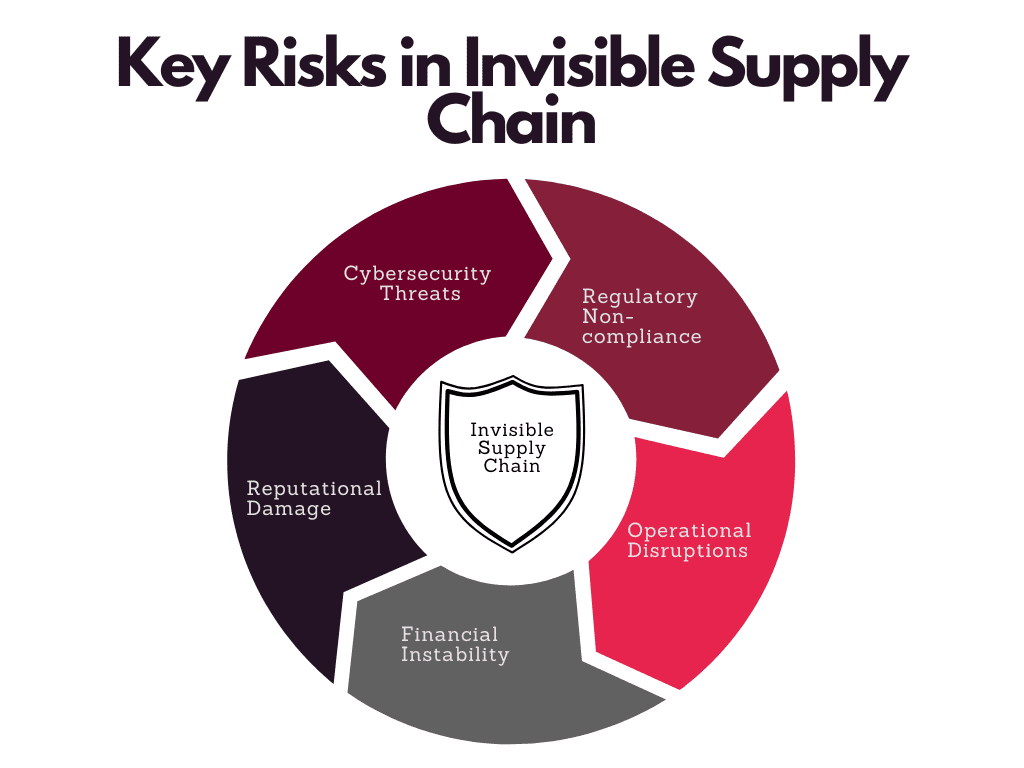
Below, we explore each of these risks in greater detail:
Cybersecurity threats: the weakest link in the chain
You might have ironclad security measures, but your supply chain is only as strong as its weakest link. Fourth-party vendors often provide IT infrastructure, cloud storage, software, or IoT connectivity, yet they don’t always have the same security controls you expect from your direct suppliers.
Why it’s a problem:
- You can’t directly oversee their cybersecurity practices.
- One compromised system at a fourth-party vendor can lead to ransomware attacks, data breaches, or stolen intellectual property.
- Attackers exploit these indirect pathways to gain access to larger targets.
How to mitigate:
- Ensure third-party vendors assess their suppliers for cybersecurity vulnerabilities.
- Require cybersecurity certifications (ISO 27001, NIST, etc.) from all vendors in the supply chain.
- Continuously monitor network activity and third-party connections for suspicious behavior.
Regulatory non-compliance: legal and financial liabilities
Governments worldwide are tightening data privacy and security regulations (e.g., GDPR, CCPA, UAE PDPL). Many of these laws hold organizations accountable for the actions of their supply chain partners, including fourth-party vendors.
Why it’s a problem:
- Lack of visibility: You may not even know where your suppliers are storing data.
- Cross-border compliance risks: subcontractors might store data in countries with weak cybersecurity laws, putting your organization at risk.
- Fines and reputational damage: governments are cracking down on data security violations, making compliance more critical than ever.
How to mitigate:
- Include compliance clauses in contracts requiring third parties to disclose who their subcontractors are.
- Mandate adherence to privacy regulations across all vendor tiers.
- Use data-centric security solutions like Seclore to control sensitive data, even if fourth parties access it.
Operational disruptions: a fragile chain with hidden dependencies
Think your supply chain is secure and stable? Think again. Many manufacturers rely on just-in-time production models, meaning any delay, shortage, or failure at a fourth-party vendor can cause massive disruptions.
Why it’s a problem:
- A hidden dependency: your supplier’s supplier might be the only source of a critical component.
- Geopolitical instability: trade restrictions, wars, or economic issues can disrupt suppliers you didn’t even know you relied on.
- Unforeseen shutdowns: if a subcontractor suddenly goes bankrupt, it could cause weeks of production delays.
How to mitigate:
- Conduct supply chain risk mapping to identify all key suppliers and their dependencies.
- Establish alternative vendors to reduce reliance on a single fourth-party supplier.
- Use AI-driven supply chain visibility tools to monitor real-time disruptions.
Financial instability: the hidden costs of unstable vendors
Fourth-party vendors may lack financial stability, and a sudden business closure or insolvency can disrupt supply chains.
Why it’s a problem:
- No direct financial oversight: Manufacturers may vet third-party vendors financially but rarely check the economic health of fourth parties.
- Small subcontractors = higher risk: Many fourth-party vendors are small businesses, making them vulnerable to economic downturns.
- Delayed payments and cash flow issues: If a fourth party struggles financially, it can delay deliveries or compromise on quality.
How to mitigate:
- Require third parties to disclose critical fourth-party suppliers and their financial stability.
- Diversify vendor relationships to avoid over-reliance on a single subcontractor.
Reputational damage: a brand’s trust is only as strong as its weakest link
If a fourth-party vendor is involved in ethically questionable practices, the manufacturer’s reputation can suffer—even if they were unaware of the vendor relationship.
Why it’s a problem:
- Lack of ethical oversight: Manufacturers may unknowingly work with fourth parties involved in labor violations, environmental harm, or unethical sourcing.
- Social media amplification: A single scandal involving a fourth-party vendor can quickly become a brand crisis.
How to mitigate:
- Conduct Environmental, Social, and Governance (ESG) audits across all supply chain tiers.
- Implement AI-driven monitoring to detect early signs of unethical practices in vendor networks.
How to identify and manage fourth-party risks
Managing fourth-party risks requires a proactive approach beyond traditional third-party risk management (TPRM) practices. Since organizations do not have direct contracts or oversight over fourth parties, they must rely on substantial due diligence, vendor transparency, and continuous monitoring to mitigate potential threats.

Below are key strategies to effectively identify, assess, and manage fourth-party risks.
Conduct supply chain audits and risk mapping
One of the biggest challenges in managing fourth-party risk is the lack of visibility. Many organizations do not know to whom their third-party vendors subcontract work, exposing them to potential cybersecurity, operational, and compliance risks.
How to do it:
- Identify critical suppliers: Start by categorizing vendors based on their impact on business operations (e.g., necessary raw materials, IT services, logistics).
- Map vendor dependencies: Require third-party vendors to disclose their key subcontractors, suppliers, and service providers.
- Assess geographic risks: Determine if fourth-party vendors operate in high-risk regions prone to political instability, economic volatility, or regulatory restrictions.
- Monitor for financial health: Conduct regular financial stability checks on key fourth parties to identify potential risks of insolvency or disruption.
Strengthening vendor contracts and due diligence
Since organizations do not have direct contracts with fourth parties, they must use third-party contracts to enforce accountability and ensure that their supply chain meets security, compliance, and ethical standards.
How to do it:
- Include fourth-party risk clauses in contracts: Require third-party vendors to disclose their subcontractors and ensure they meet compliance and cybersecurity standards.
- Mandate regular vendor security assessments: Ensure third parties conduct due diligence on their supply chain, including risk assessments and penetration testing for IT providers.
- Require adherence to data privacy laws: Contracts should include clear terms ensuring compliance with GDPR, DPDP, CCPA, and other industry-specific regulations for all vendors in the supply chain.
- Implement Service Level Agreements (SLAs): Define response times, cybersecurity controls, and compliance expectations that vendors must extend to their subcontractors.
Develop contingency plans for supply chain disruptions
Operational risks caused by fourth-party disruptions—such as supply shortages, cyberattacks, or financial instability—can cause significant delays and revenue loss. Organizations need to develop resilient contingency plans to mitigate these risks.
How to do it:
- Diversify suppliers: Reduce dependency on a single vendor or region by identifying alternative suppliers and backup partners for critical services.
- Establish emergency response protocols: Develop a crisis management plan to respond quickly to vendor failures, cyberattacks, or compliance violations in the extended supply chain.
- Perform stress tests: Simulate supply chain disruptions (e.g., shutdowns, cyber incidents, or delivery delays) to evaluate preparedness and response times.
Use AI-driven supply chain visibility tools
Modern AI-powered risk management platforms provide real-time insights into fourth-party suppliers, vendor relationships, and risk exposure. These tools help organizations track supply chain disruptions and assess vulnerabilities before they escalate.
How to do it:
- Deploy real-time monitoring tools to track vendor networks, supplier relationships, and subcontractor activities.
- Leverage AI-driven risk assessment platforms that analyze financial stability, cybersecurity risks, and compliance adherence across the extended supply chain.
- Automate third-party risk management (TPRM) workflows to continuously scan for compliance gaps, cyber threats, and operational vulnerabilities.
Implement data-centric security for vendor risk management
Since fourth-party risks are difficult to control, organizations must adopt data-centric security solutions that protect sensitive information even when shared with third- or fourth-party vendors.
How to do it:
- Apply persistent encryption: Use file-level encryption to protect data, even if it moves beyond trusted partners.
- Enforce access control policies: Restrict who can open, edit, or share sensitive data to prevent unauthorized access by fourth-party subcontractors.
- Monitor file usage in real time: Track who accesses files, from where, and what actions they perform, ensuring compliance with data protection laws.
- Enable remote revocation: If a third—or fourth-party vendor is compromised, access to shared data can be revoked instantly.
Conclusion
Fourth-party risks are often invisible, but they can seriously impact cybersecurity, compliance, operations, finances, and reputation. Without proper visibility and oversight, manufacturers leave themselves exposed to hidden supply chain threats.
By mapping supply chain risks, strengthening vendor contracts, leveraging real-time monitoring tools, and implementing data-centric security solutions, organizations can reduce vulnerabilities and build a more resilient, secure, and compliant supply chain.