Whitepaper
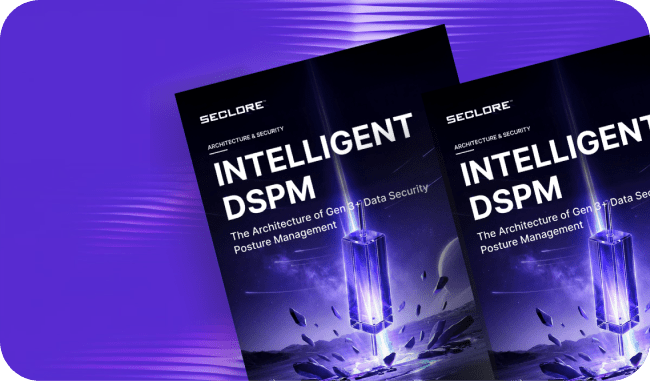
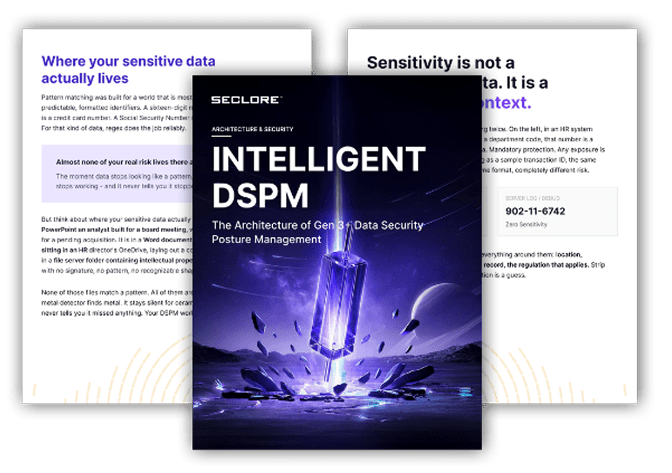
The Intelligent DSPM
A practical guide for CISOs and security architects on why DSPM must evolve from finding sensitive data to understanding it, and what sovereign-ready, context-aware classification looks like in the AI era.
What to Expect

Why finding sensitive data is no longer the same as protecting it, and where that gap costs security teams time, evidence, and trust.

Why classification is a context problem, not a pattern problem, and what it takes to reason about data, business, and regulation at once.

What sovereign-ready DSPM looks like, when data protection laws demand local processing of sensitive data, including by the AI that reads it.
Inside the Whitepaper
A cybersecurity leader’s guide to evaluating DSPM built for context, sovereignty, and remediation, not just discovery.
Why context is the real problem
Finding sensitive data is not the same as understanding it. A discovery error is a protection error in disguise, and context gap is where most tools fall short.
Why three generations of DSPM fall short
Regex cannot reason about meaning. Trainable classifiers are too slow for today’s timelines. First-wave LLM discovery ships your data to a third-party cloud.
The Semantic Triad
How intelligence is produced, by reasoning about data, business, and regulation at the same time rather than pattern-matching in isolation.
Discover, Contextualize, Enforce, Prove
Closing the loop between finding exposed data and fixing it, with protection that lives inside the same platform instead of across other tools and teams.
Sovereign-ready architecture
What it takes to classify where the data lives, now that data protection laws require sensitive data to be processed locally, including by the AI that reads it.
Evaluation criteria for security architects
The questions to run on any DSPM you are evaluating, so you can tell a tool that finds data apart from one that understands and protects it.
Who should read this?
This whitepaper is for security, compliance, and architecture leaders in regulated and sovereignty-bound industries who are evaluating DSPM alongside AI adoption.
1
CISOs and Security Leaders
Responsible for data risk posture, AI governance, and whether the tools they buy can protect data without exposing it.
2
Security and Data Architects
Evaluating DSPM architecture, deciding where classification runs, and building for sovereignty by design rather than by configuration.
3
Data Protection Officers and Compliance Heads
Accountable for lawful processing and local-processing mandates across jurisdictions, including by the AI that reads sensitive data.
4
Privacy and Legal Teams
Managing third-party and AI vendor accountability, and building an audit-defensible evidence trail from discovery through remediation.
5
CIOs and IT Heads
Integrating AI into the enterprise stack while keeping data governance controls intact across clouds, borders, and partners.
Related Resources
TRUSTED BY INDUSTRY-LEADING ENTERPRISES